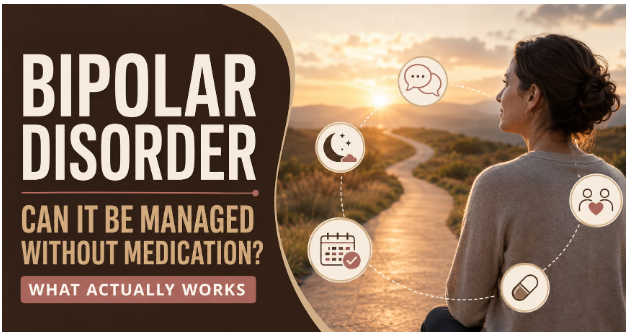
If you or someone you love lives with bipolar disorder, you have probably asked whether medication is truly necessary. Maybe the side effects worry you. Maybe a long, stable stretch has you wondering if you have outgrown it.
Here it is, up front. You can ease symptoms with therapy, sleep, and steady routines, and those habits matter more than most people think.
But for the vast majority of people, medication is the part that keeps mood episodes from taking the wheel. Skipping it is a gamble that usually costs far more than it saves.
This guide breaks down what the evidence actually shows, what genuinely helps, and where the real danger hides. At Psychiatry Relief in Houston, we build every plan around proof, not guesswork.
The Short Answer: Can You Treat Bipolar Without Medication?
People type this question a dozen ways.
Can bipolar be treated without medication?
Can bipolar be managed without medication?
Can you treat bipolar without medication?
Can bipolar be treated without medicine?
Can bipolar disorder be treated without med?
The honest answer stays the same for all of them.
You can soften the edges of the illness with lifestyle changes and counselings. You cannot reliably control the mood swings of bipolar disorder with those tools alone.
Every serious look at how to deal with bipolar without med points to the same conclusion: dropping medication raises the odds of another manic or depressive episode, and each new episode tends to make the next one harder to treat.
Picture a fire alarm in your home. Fresh batteries, a clear exit plan, and a working extinguisher all help, but none of them replaces the alarm itself.
Medication is the alarm. Everything else supports it. Take the alarm out, and you are relying on luck to catch a fire early.
So the short version is this. Medication is the foundation. The rest of this article shows you why, and how the other pieces fit around it.
What Bipolar Disorder Actually Is, and Why It Does Not Just Go Away
A lot of people quietly hope the illness will fade on its own. Two of the most common searches say it plainly: does bipolar ever go away, and does bipolar disorder ever go away.
The answer to both is the same, and it is worth being honest about.
Bipolar disorder is a long term brain condition, not a passing mood. It affects how your brain regulates energy, sleep, and emotion, and that wiring does not reset after a good year. The condition is manageable, not curable. People build full, stable, productive lives with it every day, but they do so by treating it, not by waiting it out.
What is it like to have bipolar in real terms? Most people describe a swing between two poles. On the high end, a manic or hypo manic phase can feel euphoric, wired, and unstoppable, with racing thoughts, little need for sleep, and impulsive choices that look reasonable in the moment. On the low end, a depressive phase drains energy, motivation, and hope.
The swings are not a character flaw or a lack of willpower. They come from a real, measurable difference in how the brain handles mood.
Because the illness is chronic, treatment is chronic too. That is the piece people most want to skip, and the piece that matters most.
How to Tell If It Is Bipolar: Mania, Diagnosis, and Episode Length
Recognising the pattern is the first real step toward help. A few questions come up again and again.
How to know if you are manic. Mania is more than a good mood. Warning signs include sleeping very little yet feeling energised, talking faster than usual, jumping between ideas, spending or risk taking that is out of character, and a sense that your thoughts are outrunning your mouth. If people around you seem worried while you feel great, that gap is a clue worth taking seriously.
Does someone with bipolar know they have it. Often, no, at least not at first. During a manic high, the brain can feel sharp and capable, which makes it hard to see the episode from the inside.
Many people only connect the dots after a crash, or after a loved one gently points out the pattern. That blind spot is exactly why an outside, professional read matters so much.
How long does it take to be diagnosed with bipolar. Longer than it should, in many cases. Because low phases look like ordinary depression, some people get treated for depression alone for years before the full picture comes into focus.
A careful evaluation that reviews your mood history, not just your worst week, shortens that timeline considerably.
How long can a bipolar depressive episode last. Without treatment, a depressive phase can stretch from several weeks to many months. That is one of the strongest arguments against a wait and see approach. The right plan can shorten an episode and lower the chance of the next one.
How to treat bipolar 2. Bipolar II involves hypo mania and depression rather than full blown mania, and it deserves the same seriousness as bipolar I.
Treatment leans on mood stabilisation, careful management of the depressive side, and steady monitoring. The specifics differ from person to person, which is why a tailored plan beats a template every time.
Why Medication Sits at the Center of Bipolar Treatment
Here is the part the internet often gets wrong. Search results are full of promises that the right diet, supplement, or mindset can replace your prescription. For bipolar disorder, that promise does not hold up.
Mood stabilisers and related medications do something no habit can do on its own: they steady the brain chemistry that drives the highs and lows. Lithium, for example, has decades of evidence behind it, including a track record of lowering the risk of the most dangerous outcomes.
Other stabilisers and carefully chosen medications help prevent mania, ease depression, and protect the calm stretches in between.
Left untreated, bipolar disorder rarely stays still. Episodes tend to arrive more often and hit harder over time, and each one can damage relationships, jobs, finances, and health. Medication interrupts that cycle. It is not a crutch.
It is the structure that makes everything else possible, including the therapy and lifestyle work that people are so eager to rely on.
One important safety note. If you already take medication, do not stop or change the dose on your own, even when you feel great. Sudden changes can trigger a rebound episode. Any adjustment belongs in a conversation with your prescribe.
What Is the Best Medication for Bipolar Depression?
This is one of the most searched questions in the whole category, and it deserves a real answer rather than a shrug.
There is no single best medication for bipolar depression that works for everyone. The strongest options treat the low phase without tipping you into mania, which is why standard antidepressants alone are usually a poor fit and can even make things worse.
Instead, psychiatrists often turn to certain mood stabilisers and specific agents proven for the depressive side of bipolar, sometimes paired with a stabiliser already keeping mania in check.
The right choice depends on your type of bipolar, your history, your other health conditions, and how your body responds. That matching process is medical work, not a guessing game you should run alone. A bipolar disorder psychiatrist can weigh those factors, start you on the safest fit, and adjust as your response becomes clear. If depression is the side of the illness hitting you hardest right now, that is exactly the conversation to bring in.
What Actually Works Alongside Medication
Now for the honest version of the without medication question. The strategies people hope will replace their prescription are real, they help, and they belong in your plan. They just work best as partners to medication, not substitutes for it.
Protect your sleep. Irregular sleep is one of the most reliable triggers for a mood episode. A steady sleep and wake time does real, measurable good.
Commit to therapy. Approaches like cognitive behavioural therapy teach you to spot early warning signs, challenge distorted thinking, and build coping skills that hold up under stress. Structured individual therapy turns a diagnosis into a plan you can actually follow.
Build a routine. Regular meals, movement, and daily rhythm give the brain the stability it craves. Big disruptions, even good ones, can shake the mood loose.
Cut the triggers. Alcohol and recreational drugs interfere with both medication and mood control. Reducing them protects your progress.
Line up support. People who track their own patterns and stay in touch with a trusted circle catch trouble sooner. Early is easier to treat than late.
Read that list again and notice what it is. Not a replacement for treatment, but the scaffolding that makes treatment work. Together with medication, these habits are what actually keep people well.
How to Deal With a Person With Bipolar Disorder
If you love someone with this illness, you carry a lot, and how you show up genuinely changes their outcome. Learning how to deal with a person with bipolar disorder starts with a mindset shift: their mood swings come from a medical condition, not from a choice to hurt you.
A few things help more than almost anything else.
Learn the signs. When you can spot an early shift toward mania or depression, you can encourage a check in before a small wobble becomes a full episode.
Support the treatment, gently. One of the most useful things you can do is help them stay consistent with care, especially during good stretches when the illness is easy to underestimate. You do not have to nag. You just have to stay steady.
Listen without fixing. During a depressive phase, presence beats advice. Let them know you are there, and that the low will pass with support.
Set kind, clear boundaries. Supporting someone does not mean absorbing everything. Boundaries protect the relationship so you can keep showing up over the long haul.
Take care of yourself too. You cannot pour from an empty cup. Your own support, from friends, a counsellor, or a group, keeps you strong enough to help.
The single most valuable role you can play is encouraging professional care and helping it stick. That is where lasting stability comes from.
Bipolar Disorder Treatment in Houston, TX at Psychiatry Relief
If you are searching for real answers, you do not have to sort through them alone. Psychiatry Relief in Houston offers evidence based bipolar disorder treatment in Houston, TX built around what works: careful diagnosis, medication management, therapy support, and a plan shaped to your life rather than a one size template.
Our team treats adults and teens, in person and through secure virtual visits, so care fits your schedule instead of fighting it. If your low phases keep getting mistaken for something else, we also treat overlapping conditions like depression and anxiety disorders, which matters, because an accurate diagnosis is the first step toward a plan that actually holds.
You can reach our Houston clinic at 7826 Hwy 6 N Ste 102, Houston, TX 77095 or call (832) 975 7460. When you are ready, book a confidential consultation and take the first real step toward stability. You can also learn more about our providers and how we work.
Frequently Asked Questions
“How I Cured My Bipolar” – Is a Cure Actually Possible?
You will see stories online titled “how I cured my bipolar,” and it is worth being clear eyed about them. Bipolar disorder cannot be cured, but it can be managed so well that daily life feels stable and full.
What those stories usually describe is strong management: the right medication, consistent therapy, protected sleep, and steady routines working together. That is a realistic, hopeful goal. Chasing a cure that does not exist often means abandoning the treatment that keeps you well.
What Is the Most Effective Treatment for Bipolar Disorder?
The most effective treatment for bipolar disorder is a combined one. Medication provides the mood stabilisation at the core, and therapy plus lifestyle support build durability around it. Research consistently shows that this pairing outperforms either piece on its own.
A personalised plan from a psychiatrist is the most reliable path, because it matches the treatment to your specific type, history, and needs.
How Do You Treat Bipolar Disorder With Medication?
Treatment usually begins with a thorough evaluation, then a mood stabiliser or a carefully chosen combination aimed at your specific pattern of mania, hypo mania, and depression.
Your psychiatrist monitors how you respond and fine tunes the plan over time, since the goal is steady, long term balance rather than a quick fix. Regular follow ups keep the plan working as life changes, which is exactly the kind of ongoing care we provide at Psychiatry Relief.
This article is for general education and is not a substitute for professional medical advice. If you are living with bipolar disorder, talk with a qualified psychiatric provider before starting, stopping, or changing any treatment. If you or someone you know is in crisis, contact a licensed professional or your local emergency services right away.