Written and clinically reviewed by the licensed psychiatry team at Psychiatry Relief, Houston, TX.
You wake up with a knot in your stomach and no clear reason for it. Your heart pounds before a meeting that shouldn’t feel like a big deal.
Someone asks if you’re alright, and honestly, you can’t explain what’s wrong. If you’ve ever searched why do I feel off and landed on the words “chemical imbalance,” you’re in good company. It’s the explanation most people reach for first.
The real story is more interesting than a single broken chemical, though. Anxiety grows out of a mix of brain chemistry, wiring, stress hormones, genetics, and lived experience, all working at once. Once you understand what actually happens inside your brain, the way you treat anxiety changes. It also answers the question sitting quietly underneath all of this: will anxiety go away?
At Psychiatry Relief in Houston, we help people work through exactly these questions every week. This guide breaks down the biology in plain language, then shows you what you can do about it.
Quick note: This article is for general education. It isn’t a diagnosis or personal medical advice. If anxiety is interfering with your daily life, please speak with a licensed provider.
What Is Anxiety, Really?
Anxiety is your body’s built in alarm system. When your brain senses a threat, it floods you with alertness, tension, and energy so you can react fast. That system kept our ancestors alive, and it still helps you today when you slam the brakes to avoid an accident or feel a jolt of nerves before a big interview.
The problem starts when the alarm keeps ringing after the danger is gone, or when it goes off with no real threat at all. That’s the line between everyday nerves and an anxiety disorder.
Here’s a simple example of the difference. Feeling butterflies before you speak in public is normal anxiety. Avoiding your best friend’s wedding for weeks because the thought of a toast makes you physically sick, that’s anxiety working against you. Same emotion, very different impact on your life.
Is Anxiety a Chemical Imbalance?
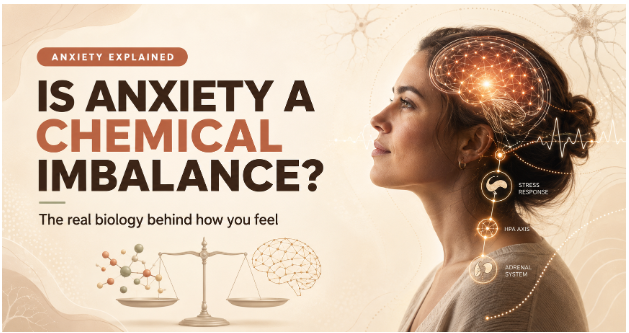
Short answer: not in the tidy way most people picture it. The idea that anxiety is simply “low serotonin” or one chemical out of balance has been repeated so often that it feels like fact. Science tells a fuller story.
The chemical imbalance theory took hold decades ago, partly because certain medications that adjust brain chemistry help many people feel better. That’s true and useful.
But a medication easing your symptoms doesn’t prove a single missing chemical caused them, the same way aspirin easing a headache doesn’t mean the headache came from an aspirin shortage.
Today, most clinicians describe anxiety as a whole brain event rather than one faulty ingredient. Your brain chemistry matters. So do the circuits those chemicals travel through, your genes, your stress load, your sleep, and everything you’ve lived through.
Anxiety sits where all of those meet. That’s why two people can have the same diagnosis and need completely different care.
What Chemical Causes Anxiety?
No single chemical causes anxiety on its own, but a few key messengers shape how anxious you feel:
- GABA is your brain’s main calming signal. It quiets overactive nerve cells. When GABA activity runs low, that brake feels weak, and worry spins more freely.
- Serotonin helps regulate mood and emotional steadiness. Shifts here can leave you feeling on edge.
- Norepinephrine drives your fight or flight surge. It’s behind the racing heart, the shakiness, and that wired feeling.
- Cortisol, your primary stress hormone, rises when you’re under pressure. Stay stressed long enough and chronically high cortisol can keep your whole system on alert.
These messengers don’t work in isolation. They rise, fall, and interact, which is closer to a busy switchboard than a broken part.
What Causes Anxiety in the Brain?
Chemistry is only half of it. The wiring matters just as much. A few regions do most of the heavy lifting:
- The amygdala is your threat detector. In many anxious brains it’s overactive, sounding the alarm at things that aren’t truly dangerous.
- The prefrontal cortex is the reasoning, “let’s think this through” part of your brain. It normally calms the amygdala down. Under chronic stress, those brakes lose grip.
- The HPA axis links your brain to your adrenal glands and controls the release of stress hormones. When it stays switched on, your body struggles to power down.
Put simply, anxiety often means an oversensitive alarm paired with a tired braking system. That’s a pattern you can work with, not a permanent flaw.
Why Do You Feel “Off”? Reading Your Body’s Signals
That vague, hard to name sense that something isn’t right is one of anxiety’s most common calling cards. It rarely announces itself politely. More often it leaks out through your body first, which is why so many people end up asking why do I feel off long before they connect it to anxiety.
Common Anxiety Symptoms
Anxiety shows up in the body and the mind at the same time. Physical signs include a racing heart, tight chest, shortness of breath, muscle tension, stomach trouble, restlessness, and trouble sleeping. Mental signs include constant worry, racing thoughts, irritability, trouble concentrating, and a sense of dread you can’t shake.
Because these overlap with plenty of physical conditions, many people visit their doctor for their heart or stomach before anyone mentions anxiety. If your medical tests keep coming back clear but you still feel wrong, anxiety is worth ruling in.
What an Anxiety Attack Feels Like
An anxiety attack, often called a panic attack, is a sudden wave of intense fear that peaks within minutes. Your heart hammers, your chest tightens, your hands tingle, and your thoughts race toward worst case scenarios. Many people are convinced they’re having a heart attack or losing control.
It feels genuinely frightening, and it is also not dangerous in itself. The surge passes. Knowing that, and learning a few grounding tools, takes much of the terror out of the experience.
The Different Types of Anxiety Disorders
Anxiety isn’t one condition. It’s a family of them, and different sources count the members differently, which is why you’ll see lists ranging from six types to eleven. What matters more than the exact number is recognizing which pattern fits you.
The six most commonly recognized anxiety disorders are:
- Generalized anxiety disorder (GAD) – ongoing, hard to control worry about everyday things.
- Panic disorder – repeated panic attacks and fear of the next one.
- Social anxiety disorder – intense fear of judgment in social situations.
- Specific phobias – strong fear of a particular object or situation, like heights or flying.
- Agoraphobia – fear of places or situations where escape feels hard.
- Separation anxiety disorder – deep distress when apart from people you’re attached to.
Broader lists add conditions such as selective mutism and closely related diagnoses like obsessive compulsive disorder (OCD) and post traumatic stress disorder (PTSD). These live in their own diagnostic categories now, but they share anxiety’s roots and often travel together, which is how you end up with a list of eleven or more.
If you want to go deeper on any one of these, our anxiety disorders page covers each in detail.
Will Anxiety Go Away?
This is the question that brings most people to us, so let’s answer it honestly. Will anxiety go away? In many cases, yes. In others, it becomes something you manage well rather than erase completely, and that distinction is good news, not bad.
Anxiety is one of the most treatable mental health conditions there is. With the right approach, most people see their symptoms shrink to the point where anxiety no longer runs their day.
Can Anxiety Go Away on Its Own?
Sometimes. If your anxiety is tied to a specific, temporary stressors, a hard week at work, a looming deadline, a rough patch, it often fades once the situation resolves. So yes, situational anxiety can go away on its own.
The harder truth is that a true anxiety disorder rarely clears up by waiting it out. When worry has been present for months, shows up without a clear trigger, and keeps disrupting your life, hoping it disappears usually just delays relief. That’s the point to reach out for support.
Will Anxiety Ever Go Away With the Right Treatment?
Here’s the encouraging part. Can anxiety ever go away with proper care? For a great many people, symptoms fade so far into the background that daily life feels normal again. Therapy, especially approaches like cognitive behavioural therapy and EMDR therapy for trauma linked anxiety, retrains that oversensitive alarm system.
Medication, when it fits, steadies the chemistry while you build new skills. Lifestyle changes around sleep, movement, and stress round it out.
So when someone asks will anxiety ever go away, the realistic answer is that you can absolutely reach a place where it no longer controls you. Some people reach full remission. Others keep a small toolkit for occasional flare ups. Both count as winning.
How to Reduce Anxiety Immediately
When anxiety spikes, you need something that works in the moment. These techniques won’t cure an anxiety disorder, but they can pull you back from the edge fast:
- Slow your breathing. Breathe in for four counts, hold for four, out for six. A longer exhale signals your body to stand down.
- Ground yourself with your senses. Name five things you see, four you can touch, three you hear, two you smell, one you taste. It yanks your mind out of the spiral.
- Move your body. A brisk walk or even shaking out your arms burns off the stress chemicals fuelling the surge.
- Splash cold water on your face. The cool shock can slow a racing heart within seconds.
Keep one or two of these ready before you need them. Practising when you’re calm makes them far easier to reach for when you’re not.
When to Talk to a Doctor About Anxiety
If anxiety has settled in for weeks and started shrinking your world, it’s time for professional help. A big worry we hear is confusion over who to see and what they can actually do, so let’s clear that up.
Can a Primary Care Doctor Prescribe Anxiety Medication?
Yes. Can a primary care doctor prescribe anxiety medication? They can. If you’re wondering can my general practitioner prescribe anxiety medication or can a PCP prescribe anxiety meds, the answer is that most family doctors handle mild to moderate anxiety, including starting a prescription.
That said, a psychiatrist brings specialised training in how these medications work, how to fine tune them, and what to do when the first option isn’t the right fit. For anxiety that’s persistent, severe, or tangled up with other conditions, seeing a psychiatric provider often gets you to relief faster.
How to Ask Your Doctor for Anxiety Medication
Many people feel awkward raising this, so here’s a simple script for how to ask your doctor for anxiety medication. Be direct and concrete: describe your main symptoms, how long they’ve lasted, and how they affect your work, sleep, and relationships.
You might say, “I’ve had constant worry and trouble sleeping for a few months, and it’s affecting my job. I’d like to talk through my treatment options, including medication.” Clear, honest details help your provider help you.
What Do They Give You at the Hospital for Anxiety?
If a panic attack lands you in the ER, you may wonder what do they give you at the hospital for anxiety. Emergency staff first rule out physical causes like heart problems. Once you’re cleared, they may offer a fast acting calming medication to settle an acute episode. Hospital care handles the crisis in front of you. It isn’t a long term plan, which is why ongoing outpatient care matters so much afterward.
Anxiety Disorder Treatment in Houston, TX at Psychiatry Relief
Understanding the biology is a start. Doing something with that knowledge is where life actually changes. That’s the work we do at Psychiatry Relief in Houston.
Our Anxiety Disorder Treatment in Houston, TX looks at the whole picture, your chemistry, your history, your stress, and your goals, then builds a plan that fits you rather than a template. That can include individual therapy, medication management, trauma focused approaches like EMDR, or a blend, adjusted as you go.
Anxiety also rarely travels alone. It often overlaps with depression, trauma, or major life stress, and we treat those connections instead of ignoring them. For patients whose anxiety is bound up with the strain of an immigration case, family separation, relocation, fear, or past trauma, our immigration evaluation service provides objective, trauma informed clinical documentation prepared by licensed psychiatrists, supporting both your well being and, where relevant, your case paperwork.
You don’t have to keep white knuckling through this. Book an appointment or get in touch with our team, and learn more about our clinicians and how we work.
Frequently Asked Questions (FAQs)
What is anxiety? Anxiety is your body’s natural response to perceived threat, marked by worry, tension, and physical arousal. It becomes a disorder when it’s excessive, sticks around, and interferes with daily life.
What is the meaning of anxiety, with an example? Anxiety means a state of unease or fear about something uncertain. An everyday example is lying awake replaying a small work comment for hours, convinced it caused a problem it didn’t.
What causes anxiety in the brain? An overactive amygdala (your threat detector) combined with a prefrontal cortex that can’t fully calm it, plus a stress hormone system that stays switched on. Neurotransmitters like GABA, serotonin, and norepinephrine shape how strong the response feels.
What are the 6 types of anxiety disorders? Generalized anxiety disorder, panic disorder, social anxiety disorder, specific phobias, agoraphobia, and separation anxiety disorder. Broader lists add related conditions such as OCD and PTSD.
What is an anxiety attack? A sudden, intense wave of fear that peaks within minutes, bringing a racing heart, chest tightness, and a sense of dread. It’s frightening but not physically dangerous, and it passes.
What are common anxiety symptoms? A racing heart, tight chest, shortness of breath, muscle tension, stomach upset, restlessness, poor sleep, constant worry, racing thoughts, and trouble concentrating.
How can I reduce anxiety immediately? Slow your breathing with a long exhale, ground yourself using your five senses, move your body, or splash cold water on your face to interrupt the surge.
Will anxiety go away? Often, yes. Situational anxiety can fade on its own, and a true anxiety disorder responds very well to therapy, medication, and lifestyle changes. Most people reach a point where anxiety no longer controls their life.
Read more: What Science Says About Whether It’s Permanent or Treatable