
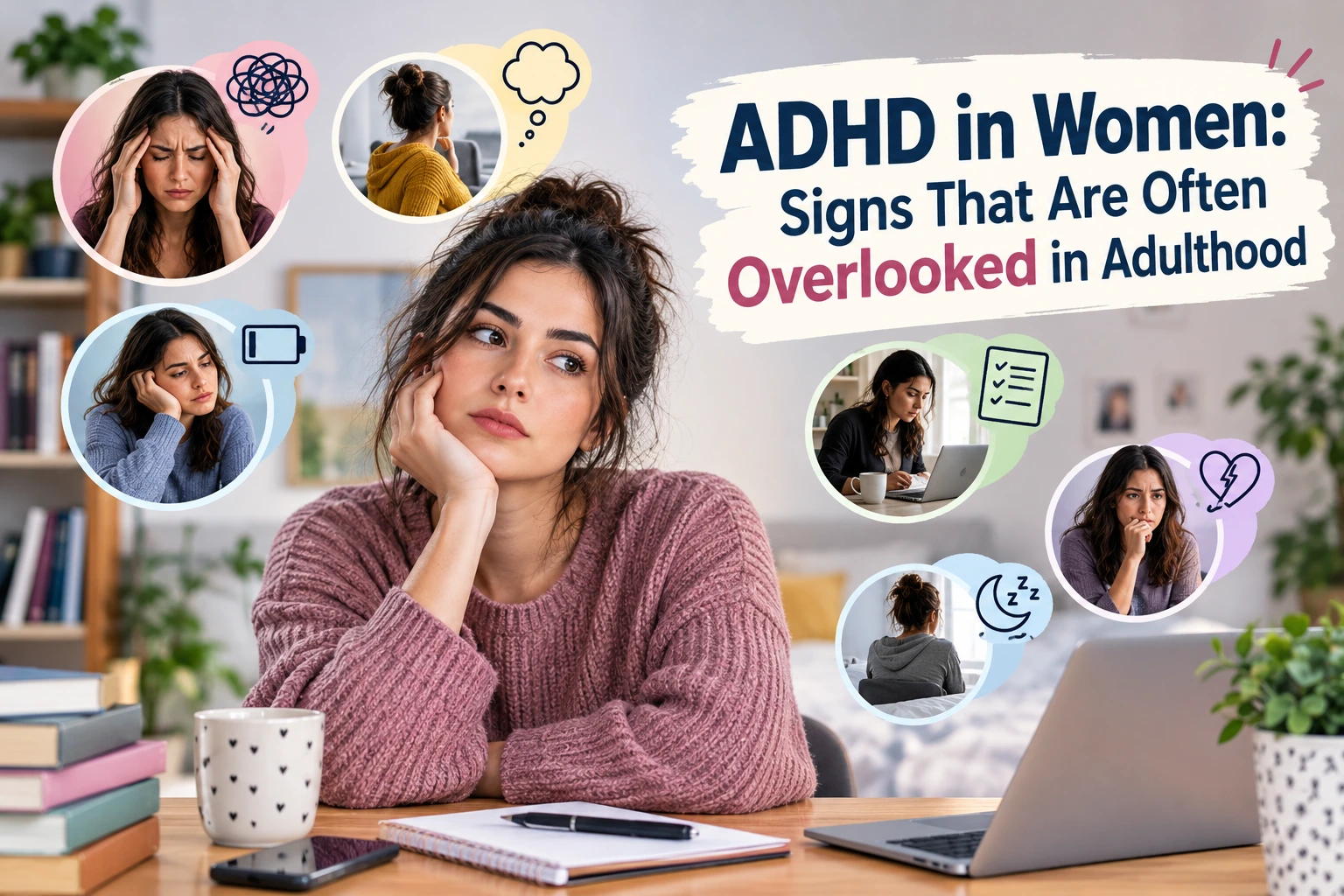
ADHD symptoms in women adults often look like chronic overwhelm instead of the hyperactivity most people expect. You might lose your keys daily, miss deadlines you swore you’d hit, zone out in meetings, or cry over small criticisms. Meanwhile, you work twice as hard as everyone else to hide it. Those are common signs of ADHD in women, and many go years without a diagnosis because the picture rarely matches the stereotype of a boy bouncing off the walls.
If that paragraph felt uncomfortably familiar, keep reading. We’ll walk through the signs doctors miss, explain why women get overlooked, and show you what an evaluation looks like. Our team at Psychiatry Relief in Houston, TX, sees adult women every week who finally find an explanation after decades of feeling “just a bit much” or “not trying hard enough.”
Why ADHD in women goes unnoticed
Most early research on ADHD focused on hyperactive boys, so the checklists grew around them. Girls more often have the inattentive type. They daydream, they doodle, they forget their homework, and they get labeled “spacey” or “sensitive.” Nobody sends a quiet kid to the principal’s office, so nobody investigates.
By adulthood, the pattern hardens. A woman who learned to cope with sticky notes, late nights, and sheer willpower looks competent from the outside. Then life gets bigger. A new job, a baby, a divorce, or perimenopause piles on more than her workarounds can handle, and things start to slip. That’s often when she finally walks into a clinic.
Signs of ADHD in adult women that people overlook
Adult ADHD symptoms in females don’t always show up as the usual list. Here are the ones we hear about most.
Constant mental noise. Many women describe a brain that never switches off. It’s not restless legs, it’s a restless mind, with ten tabs open and no way to close them.
Executive dysfunction. Executive dysfunction in women shows up as trouble starting tasks, switching between them, or finishing what you’ve begun. You know what to do. You just can’t make yourself do it, and then you feel ashamed for not doing it.
Time blindness. You think a task will take twenty minutes, and it takes two hours. You’re late again, though you left early.
Emotional dysregulation. Emotional dysregulation and ADHD often travel together. A sharp comment from a boss can flatten you for days, and frustration can spill out faster than you’d like. People call it “too sensitive,” but it’s often part of the same wiring.
Chronic disorganization with a hidden cost. Your house may look fine when guests come, because you spent the whole day panic-cleaning. The effort behind that calm is the tell.
Forgetfulness that affects relationships. You miss birthdays, forget what you promised, and lose the thread mid-conversation, even with people you love.
Hyperfocus. You can lose six hours to a project you care about and forget to eat, then struggle to start a ten-minute task you don’t.
ADHD masking in women
ADHD masking in women deserves its own section, because it hides so much. Masking means covering your symptoms to fit in. You rehearse conversations, you over-prepare for everything, you apologize before anyone complains, and you copy how other people seem to manage.
Women learn to mask early, often because they were taught to be agreeable and tidy. It works for a while. The price is exhaustion, anxiety, and a creeping belief that you’re faking being a functional adult. Many patients tell us they felt like imposters their entire lives, and they were relieved to learn it wasn’t a personality flaw.
[Dr. Urooj or your ADHD clinician: add 2 to 3 sentences about what masking looks like in the patients you see, in your own words.]
How ADHD presents differently in women
How ADHD presents differently in women comes down to a few patterns. Inattention usually outweighs hyperactivity, and what hyperactivity there is tends to turn inward, as racing thoughts or constant fidgeting with hair or nails rather than running around. Women also tend to carry more emotional weight and more self-blame. Plus, they often take on caregiving roles that magnify the strain, so the cracks appear when the family needs them most.
This is why inattentive ADHD in women gets missed. A doctor hears “anxious” or “depressed” and treats that. Those conditions can be real, and ADHD frequently overlaps with them, but treating only the anxiety leaves the root cause untouched.
ADHD symptoms in women over 30 and hormones
Many women get diagnosed in their 30s, 40s, or beyond. Often, the trigger is a life shift, such as a promotion, motherhood, or a child’s own ADHD diagnosis that makes her think, “Wait, that sounds like me.”
ADHD and hormonal changes in women matter here too. Estrogen influences dopamine, a brain chemical tied to focus and motivation. Many women notice symptoms swing across their menstrual cycle, with focus and mood dipping in the days before a period. Pregnancy, postpartum, and perimenopause can also make symptoms louder. Hormones don’t cause ADHD, but they can strip away the coping tricks that used to work. If your focus fell apart around perimenopause, that’s worth mentioning in an evaluation.
Undiagnosed ADHD in women and what it costs
Undiagnosed ADHD in women rarely stays quiet. It tends to show up as something else: long-term anxiety, depression, burnout, or trouble in relationships. Some women turn to alcohol, caffeine, or overworking to cope. Others stop trusting themselves after years of hearing they’re lazy or careless.
If you’ve been treated for anxiety or depression and still feel stuck, ADHD may be part of the picture. Our care for anxiety disorders and depression looks at the whole person, including conditions that travel together.
When to consider an ADHD assessment
Consider getting evaluated if these patterns have followed you for years and across settings, such as work, home, and friendships. A few questions can help. Did you struggle to focus in school, even if your grades were fine? Do you feel constantly behind, no matter how hard you try? Does your own mind feel louder than other people’s?
Honest answers don’t make a diagnosis, but they tell you whether a conversation with a professional is worth it. For background, the National Institute of Mental Health offers a solid overview of ADHD.
How to get diagnosed with ADHD as an adult woman
People ask how to get diagnosed with ADHD as an adult woman more than almost anything else, so here’s the plain version. There’s no blood test or brain scan. Diagnosis rests on a thorough clinical conversation, often called an ADHD assessment for adults.
You can expect your clinician to ask about your symptoms now, your childhood, school, work, and relationships, and your health, sleep, and mood. They’ll often use rating scales and may ask a family member to weigh in. Diagnosis requires that symptoms started in childhood (before age 12) and cause trouble in more than one area of life, and the clinician needs to rule out other causes, such as thyroid problems, sleep disorders, or anxiety.
Our ADHD care page explains how our evaluations work. If the answer is yes, treatment may include medication, therapy, coaching skills, or a mix, depending on you. Individual sessions through our individual therapy services can help you build routines that stick.
[Dr. Urooj or your ADHD clinician: add one real observation, such as what women most often say after they receive a diagnosis.]
Looking for ADHD care in Houston?
A diagnosis isn’t a label, it’s a map. Once you know what’s going on, you can stop blaming yourself and start working with your brain. Our office is at 7826 Hwy 6 N, Ste 102, Houston, TX 77095, and we also offer secure telehealth visits for people who’d rather meet from home.
Book your evaluation at Psychiatry Relief
You’ve spent years working harder than you should have to. At Psychiatry Relief, our Houston team offers careful psychiatric evaluations, medication management, and supportive therapy. We’ll listen to your history, answer your questions, and recommend a plan that fits your life.
Ready for answers? Book your appointment today or call +1 (832) 975-7460. One call can start it.
Frequently Asked Questions
What are the most common ADHD symptoms in women adults?
Common signs include chronic disorganization, trouble starting or finishing tasks, forgetfulness, time blindness, a racing mind, and intense emotional reactions. Many women also feel constantly overwhelmed.
Why is ADHD missed in women?
Women often have the inattentive type, which looks quieter than hyperactive ADHD. They also tend to mask symptoms, and clinicians may diagnose anxiety or depression first.
Can you develop ADHD as an adult?
ADHD begins in childhood, but many women don’t realize it until adulthood. Symptoms can become obvious when life demands rise or hormones shift.
Do hormones affect ADHD symptoms in women?
They can. Estrogen interacts with dopamine, so symptoms may change across the menstrual cycle and during pregnancy, postpartum, or perimenopause.
How long does an adult ADHD assessment take?
It depends on the clinic and your history. Many evaluations take one or more appointments, so ask our office what to expect before your visit.
Is ADHD treatable in adult women?
Yes. Treatment often combines medication, therapy, and practical skills for routines and focus. Your clinician will tailor a plan to your needs.