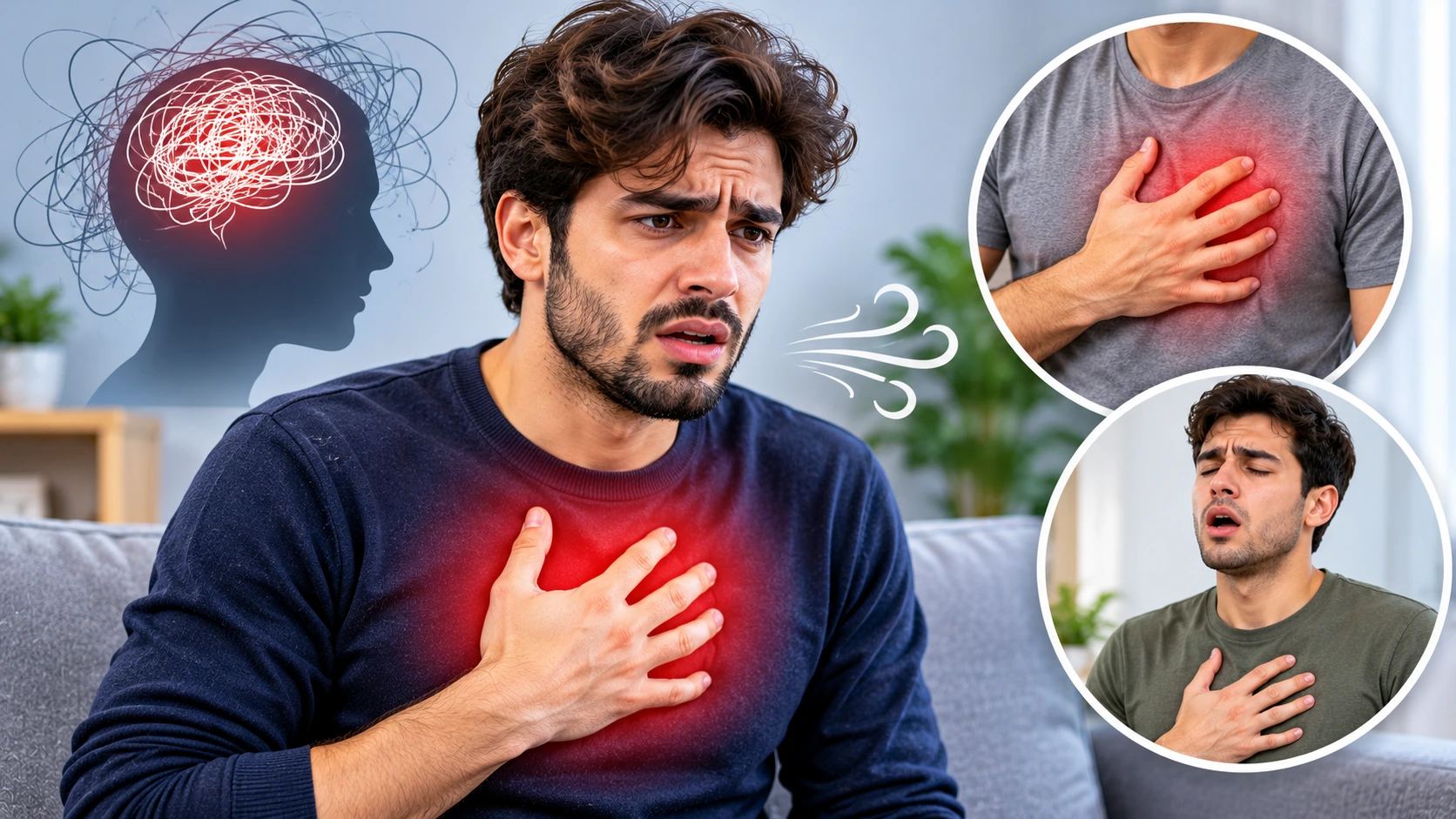
Can anxiety cause chest tightness and shortness of breath? Yes, and it’s one of the most common ways anxiety shows up in the body. Your alarm system speeds up your breathing, tightens the muscles around your ribs, and sets your heart pounding. It feels exactly like something is wrong with your heart or lungs, which is why people end up in the ER convinced they’re dying. One rule matters more than everything else in this article: if you have crushing chest pain, pain that spreads to your arm or jaw, fainting, or cold sweats, call 911 first. Figure out the cause later.
We see this a lot at our Houston practice. Someone comes in after a scary night, has been told by a doctor that their heart is fine, and still can’t shake the feeling that it isn’t. Nobody is imagining it. The sensations are real, even when the danger isn’t. Let’s walk through why this happens and what helps.
Why anxiety squeezes your chest
Think about the last time a car swerved into your lane. Your heart slammed, your breath went shallow, and your whole body locked up. That’s the fight or flight response, and it evolved to get you ready to run.
The problem is that your body doesn’t care whether the threat is a truck or a worry about Monday’s meeting. Anxiety pulls the same lever. Stress hormones flood in, your heart works harder, and the muscles between your ribs clench. That clenching is a big part of anxiety chest tightness. People describe it as a band, a weight, or a fist.
Breathing goes sideways too. When you’re anxious, you tend to breathe fast and high in the chest. Do that long enough and the balance of oxygen and carbon dioxide in your blood shifts, which can leave you dizzy, tingly, and gasping even though you’re moving plenty of air. Then you notice the strange feeling, get more scared, and breathe even faster. It’s a loop, and it feeds itself.
What it actually feels like
Shortness of breath from anxiety doesn’t feel the same for everyone. Some people can’t seem to take a satisfying breath. Others sigh and yawn constantly, as if they’re always a little behind on air. A few describe it as air going in but not “landing” anywhere.
These anxiety breathing problems usually bring friends: a racing pulse, tingling hands, a flipping stomach, lightheadedness. Doctors lump them together as anxiety-related breathing difficulties, and the overlap is exactly what makes it so frightening. Every one of those symptoms can also look like something medical, so your brain draws the worst conclusion.
Can anxiety cause chest pain?
It can. So can anxiety cause chest pain in addition to tightness? Yes. Some people feel a sharp jab, others a dull ache or a burn. The pain often moves around or changes when you shift position or take a breath, which hints that muscles are involved. But don’t treat that as a test you can run on yourself. Heart problems can be confusing too.
Chest pressure from anxiety tends to feel like someone sat down on your sternum. It can pass in a few minutes or stick around for hours during a rough patch. It’s miserable, but once a doctor has ruled out other causes, it’s usually not dangerous.
Panic attack or heart attack?
You can’t reliably tell at home, and no one expects you to. Doctors will tell you the same thing: when in doubt, get checked. That said, a few patterns are worth knowing.
A panic attack with chest discomfort usually builds quickly, peaks within about ten minutes, and fades. It may bring trembling, a sense that things aren’t real, or the fear that you’re losing control. An anxiety attack with shortness of breath often follows a stressful trigger, though sometimes it seems to come from nowhere.
A heart attack looks different. Pressure or pain often worsens with exertion or doesn’t ease with rest. It may spread to the arm, shoulder, neck, or jaw, and it can come with cold sweats, nausea, or sudden weakness. The American Heart Association lists the full set of warning signs. Women sometimes have quieter symptoms, like unusual fatigue, nausea, or back pain.
So call 911 if chest pain comes with any of those signs, if it’s new and severe, or if you have risk factors like high blood pressure, diabetes, smoking, or a family history of heart disease. Don’t drive yourself.
How to relieve anxiety chest tightness
Once a doctor has ruled out a medical cause, you can start practicing ways to ease an episode. These won’t cure anything, but they can help you ride out a wave.
If you want to know how to relieve anxiety chest tightness right now, start with your breath. Diaphragmatic breathing for anxiety uses the big muscle below your lungs that’s supposed to do most of the work. Sit or lie down and put a hand on your belly. Breathe in through your nose for about four counts, letting your belly rise, then out through pursed lips for about six. Keep going for a few minutes. The long exhale is the part that tells your nervous system it can stand down.
Grounding helps too. Name five things you can see, four you can touch, three you can hear, two you can smell, and one you can taste. Press your feet into the floor. It sounds too simple to matter, but pulling your attention outward breaks the loop surprisingly often. Roll your shoulders, stretch your chest, or walk around the block. A warm shower can loosen things up.
Longer term, cutting back on caffeine and protecting your sleep makes a real difference, because both feed the same alarm system. And try to be patient. These physical symptoms of anxiety usually fade within minutes to an hour once your body settles.
Why it keeps coming back
If it happens often, your body may be stuck on high alert. Chronic stress, ongoing worry, past trauma, and conditions like generalized anxiety disorder or panic disorder can all keep the alarm primed. The National Institute of Mental Health explains how these disorders work.
Racing thoughts often play a part. If your mind never rests, your body doesn’t either, and our post on why you overthink everything goes into that loop. Low mood can add to it, so if you’re feeling flat as well as anxious, our care for depression may be worth a look.
When to seek help for anxiety chest symptoms
People ask when to seek help for anxiety chest symptoms, and the answer has two parts. For chest pain with any heart attack warning sign, go to the ER. For new chest symptoms of any kind, see your primary care doctor soon, so a medical cause gets ruled out before anyone assumes it’s anxiety.
After that, reach out to a mental health professional if episodes keep returning, if you’ve started avoiding places or activities because you fear another one, or if the symptoms are hurting your sleep, work, or relationships. You don’t need to wait until it’s unbearable. Anxiety usually loosens its grip faster when you treat it earlier.
What treatment looks like
Anxiety responds well to treatment, even when it feels enormous. Cognitive behavioral therapy teaches you how the body’s alarm works, how to challenge the thoughts that keep setting it off, and how to face feared situations a step at a time. Breathing and relaxation skills usually come along for the ride. Some people also do better with medication, and a psychiatrist can talk through whether it makes sense for you. The choice stays yours.
At Psychiatry Relief, we start with a full psychiatric evaluation. We ask about your symptoms and your health history, and we’ll work with your medical doctor when that helps. You can read more about our anxiety disorders care, and our individual therapy gives you a private place to work on what’s behind the symptoms.
Get help in Houston
You shouldn’t have to wonder whether every tight breath is something serious. At Psychiatry Relief, our Houston team offers psychiatric evaluations, therapy support, medication management, and secure telehealth visits. We’ll listen first, then build a plan around what you’re feeling.
Our office is at 7826 Hwy 6 N, Ste 102, Houston, TX 77095.
Ready to feel more at ease in your own body? Book your appointment today or call +1 (832) 975-7460. One call is enough to get started.
If you’re in crisis or thinking about harming yourself, call or text 988, the Suicide & Crisis Lifeline, at any hour.
Frequently Asked Questions
Can anxiety really cause chest tightness and shortness of breath?
Yes. Anxiety triggers the fight or flight response, which tightens chest muscles and speeds up breathing. If the symptoms are new, a doctor should rule out heart and lung causes first.
How long does anxiety chest tightness last?
It often fades within minutes to an hour as you calm down. During a long stretch of stress, it can linger or come and go for hours or days.
How can I tell if chest pain is anxiety or a heart problem?
You can’t always tell on your own. Pain that spreads to the arm or jaw, sweating, nausea, fainting, or worsening with exertion needs emergency care, so call 911 when in doubt.
What helps anxiety shortness of breath fast?
Slow diaphragmatic breathing with a longer exhale than inhale often helps. Grounding exercises and sitting or lying down can also ease it.
Can panic attacks cause chest pain?
Yes. Panic attacks commonly bring chest pain or pressure, a pounding heart, and shortness of breath. They usually peak within about ten minutes, but get checked the first time.
When should I see a doctor about anxiety chest symptoms?
See a doctor soon for any new chest symptoms to rule out medical causes. If episodes keep returning or disrupt daily life, a mental health professional can help.