
If you have ever searched for mental health support, you have probably run into both terms psychology and psychiatry. They sound similar. They both involve mental health. And yet they are genuinely different in ways that matter enormously when you are trying to get the right help.
So what exactly is the difference between psychology and psychiatry? Which professional should you see? And how do you know what kind of care your situation calls for?
This guide answers all of that — clearly, honestly, and without the confusing medical jargon.
What Is Psychiatry?
Psychiatry is a branch of medicine focused on the diagnosis, treatment, and prevention of mental health disorders. A psychiatrist is first and foremost a medical doctor (MD or DO) who then completes a specialized residency in psychiatry after medical school.
Because psychiatrists are fully licensed physicians, they can:
- Diagnose mental health conditions through psychiatric evaluation
- Prescribe and manage psychiatric medications such as antidepressants, mood stabilizers, and antipsychotics
- Order and interpret lab work, brain imaging, and other medical tests
- Treat complex cases where mental health conditions overlap with physical health issues
- Provide medication management with ongoing monitoring and adjustments
At Psychiatry Relief in Houston, Dr. Urooj Saeed is a board-certified psychiatrist who provides comprehensive psychiatric evaluation in Houston and personalized medication management for a wide range of conditions — from depression and anxiety to bipolar disorder and PTSD.
What Is Psychology?
Psychology is the scientific study of human behavior, thought, and emotion. A psychologist holds a doctoral degree — typically a PhD or PsyD — in psychology, but is not a medical doctor. This is one of the most important distinctions to understand.
Psychologists are highly trained in:
- Psychological testing and assessment — evaluating cognitive function, personality, learning disabilities, and emotional health
- Psychotherapy — providing structured talk therapy using evidence-based methods
- Behavioral therapy — identifying and changing unhealthy patterns of thought and behavior
- Research, academic teaching, and clinical consultation
In most U.S. states, psychologists cannot prescribe medication. Their primary tool is therapy and they are exceptionally skilled at it.
Psychology vs Psychiatry vs Psychotherapy — What Is the Difference?
This is where many people get confused, so let us break it down simply.
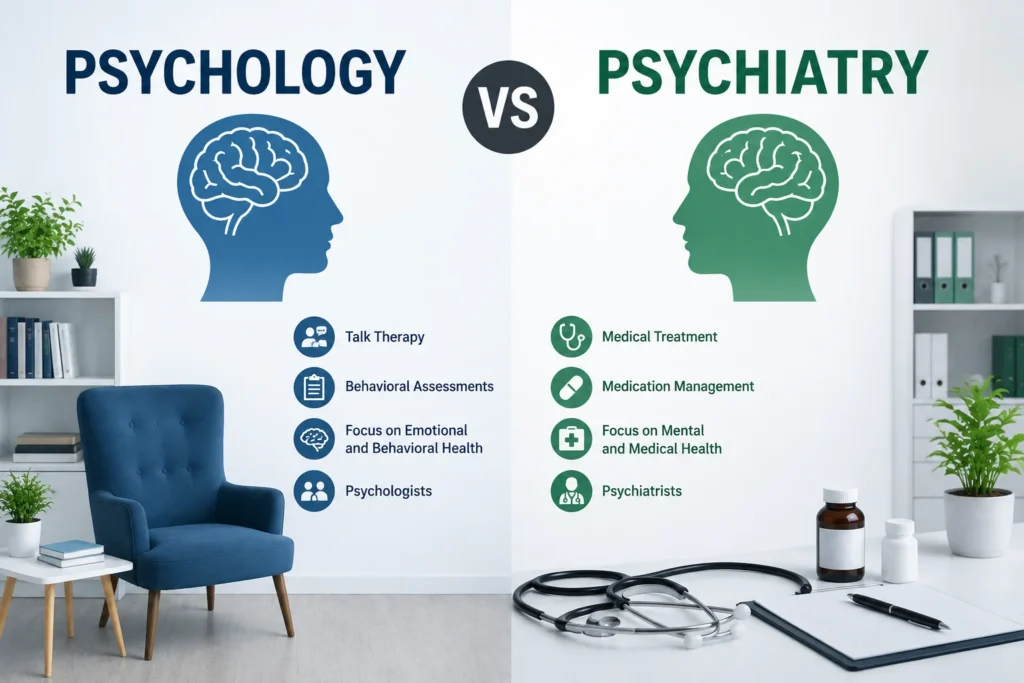
Psychiatry → Medical specialty. Focuses on diagnosis and medication management. Performed by a psychiatrist (MD/DO).
Psychology → Doctoral-level discipline. Focuses on assessment, research, and talk therapy. Performed by a psychologist (PhD/PsyD).
Psychotherapy → A treatment method, not a profession. Both psychiatrists and psychologists can provide psychotherapy treatment. Therapists, licensed counselors, and social workers can also deliver it. If you are exploring this option, our Individual Therapy in Houston offers a confidential, one-on-one space to work through your specific challenges.
Think of it this way: psychotherapy is a tool. Psychiatry and psychology are the professional fields that use it — along with other tools specific to each discipline.
Psychologist vs Psychiatrist – Which Is Better?
This is one of the most Googled questions in mental health — and the honest answer is: neither is universally better. The right choice depends entirely on your needs.
Here is a practical breakdown:
See a Psychiatrist If You:
- Need a formal mental health diagnosis
- Are considering or currently taking psychiatric medication
- Have a complex condition such as bipolar disorder, schizophrenia, or severe depression
- Have tried therapy without sufficient improvement
- Need medication management alongside therapy
- Require a psychiatric evaluation in Houston for work, legal, or clinical purposes
See a Psychologist If You:
- Want structured, ongoing psychotherapy treatment
- Are dealing with relationship issues, grief, phobias, or mild-to-moderate anxiety
- Need psychological testing or cognitive assessment
- Prefer a non-medication approach to mental health care
See Both If You:
- Have a diagnosed condition that benefits from both medication management and therapy
- Are managing depression and anxiety with multiple symptoms
- Want a comprehensive, integrated approach to your mental wellness
At Psychiatry Relief, we believe in integrated mental health care — which is why our services are designed to address both the biological and behavioral dimensions of mental health conditions. Explore our full range of psychiatric services in Houston to find the right fit for your needs.
What Does a Psychiatrist Do?
A psychiatrist does far more than simply prescribe medication. Here is what a typical psychiatric care journey looks like at a practice like Psychiatry Relief:
Step 1 — Psychiatric Evaluation Your first appointment involves a comprehensive evaluation. Dr. Saeed reviews your mental health history, current symptoms, medical background, lifestyle factors, and treatment goals. This mental health diagnosis session forms the foundation of your entire care plan.
Step 2 — Diagnosis Based on the evaluation, your psychiatrist identifies any diagnosable conditions — such as major depressive disorder, generalized anxiety disorder, PTSD, ADHD, bipolar disorder, or others.
Step 3 — Treatment Planning Your psychiatrist creates a personalized treatment plan. This may include medication, therapy referrals, lifestyle recommendations, or a combination of approaches.
Step 4 — Medication Management If medication is appropriate, your psychiatrist prescribes the right type, monitors your response, adjusts dosages as needed, and manages any side effects — all with your ongoing input and comfort in mind.
Step 5 — Ongoing Care Mental health is not a one-appointment matter. Regular follow-ups ensure your treatment continues to work as your life and needs evolve.
What Does a Psychologist Do?
A psychologist’s primary role is to understand and treat mental health through the power of conversation, assessment, and evidence-based therapy.
Specifically, psychologists:
- Conduct psychological testing to assess IQ, memory, personality, and learning differences
- Deliver behavioral therapy to help patients change harmful thought and behavior patterns
- Provide long-term psychotherapy treatment for trauma, grief, anxiety, depression, and relationship issues
- Collaborate with psychiatrists when a patient needs both therapy and medication
Common therapy methods psychologists use include Cognitive Behavioral Therapy (CBT), Dialectical Behavior Therapy (DBT), and Acceptance and Commitment Therapy (ACT). According to the American Psychological Association (APA), psychotherapy is one of the most effective tools available for treating a broad range of mental health conditions, particularly when tailored to the individual’s needs and delivered by a trained professional.
Psychologist vs Psychiatrist for Depression and Anxiety
If you are dealing with depression and anxiety, you may wonder which professional is the right starting point. The answer depends on the severity of your symptoms.
For mild-to-moderate depression or anxiety, starting with a psychologist or licensed therapist for behavioral therapy and psychotherapy is often very effective. Many people experience significant improvement through therapy alone.
For moderate-to-severe depression or anxiety — especially when symptoms are significantly disrupting your daily life, sleep, work, or relationships — a psychiatrist is typically the better first call. A psychiatric evaluation can quickly determine whether medication is necessary, and your psychiatrist can coordinate therapy as part of a broader treatment plan.
For depression and anxiety that has not responded to therapy alone, seeing a psychiatrist for medication management alongside continued therapy tends to produce the best long-term outcomes.
At Psychiatry Relief, we provide specialized Depression Treatment in Houston and Anxiety Disorder Treatment combining psychiatric expertise with compassionate, personalized care.
Key Differences at a Glance
| Feature | Psychiatrist | Psychologist |
|---|---|---|
| Degree | MD or DO (Medical Doctor) | PhD or PsyD (Doctoral) |
| Can prescribe medication | Yes | No (in most states) |
| Provides therapy | Yes | Yes |
| Conducts psychological testing | Limited | Yes |
| Treats complex/severe conditions | Yes | Moderate cases |
| Performs psychiatric evaluation | Yes | Assessment only |
| Focus | Biological + behavioral | Behavioral + cognitive |
How Are Psychiatry and Psychology Similar?
Despite their differences, psychiatry and psychology share the same fundamental goal: helping people achieve better mental health and emotional wellbeing.
Both fields:
- Treat conditions like depression, anxiety, PTSD, and OCD
- Use evidence-based psychotherapy treatment methods
- Prioritize the therapeutic relationship between provider and patient
- Emphasize individualized, patient-centered care
- Work best when they collaborate together as part of an integrated mental health care provider team
In fact, some of the best mental health outcomes occur when a psychiatrist and psychologist work together on the same patient’s care — the psychiatrist managing the biological side through medication, and the psychologist addressing the cognitive and behavioral dimensions through therapy.
Why Choosing the Right Mental Health Care Provider Matters
Choosing the wrong type of provider does not just waste time — it can delay the relief you need. Someone with severe, medication-responsive depression who spends months in therapy alone may continue to suffer unnecessarily. Conversely, someone whose anxiety is rooted in learned behavioral patterns may not need medication at all.
The right starting point is an honest conversation with a qualified professional who can assess your complete picture and point you in the right direction.
That is exactly what we do at Psychiatry Relief. Our psychiatric evaluation in Houston is designed to give you clarity — a clear diagnosis, a clear explanation of your options, and a clear path forward.
Whether you need medication management, a referral to therapy, or a fully integrated treatment plan, we meet you exactly where you are.
Psychiatry Services in Houston — What We Offer
At Psychiatry Relief, our services are built around your specific mental health needs. Dr. Urooj Saeed provides:
- Comprehensive Psychiatric Evaluations — for adults and adolescents
- Medication Management — personalized, carefully monitored prescribing
- Depression Treatment — learn more here
- Anxiety Disorder Treatment — learn more here
- PTSD and Trauma Care — including EMDR Therapy
- Bipolar Disorder Treatment — learn more here
- Telehealth Appointments — flexible, secure, and convenient
We serve patients across Houston, TX and surrounding areas — both in-person and via telehealth.
Ready to Take the Next Step?
Now that you understand the difference between psychology and psychiatry, you are better equipped to make the right decision for your mental health. If you are unsure where to start, a psychiatric evaluation in Houston is always a strong first move — it gives you answers, direction, and a professional opinion you can trust.
Book your appointment with Psychiatry Relief today and take the first real step toward feeling better.
Frequently Asked Questions (FAQs)
Q1: What is the main difference between psychology and psychiatry?
The core difference between psychology and psychiatry lies in medical training and treatment tools. A psychiatrist is a medical doctor (MD/DO) who can diagnose mental health conditions, prescribe medication, and provide therapy. A psychologist holds a doctoral degree (PhD/PsyD) and specializes in psychological testing, behavioral therapy, and psychotherapy — but cannot prescribe medication in most U.S. states. Both professionals treat mental health conditions, but through different approaches.
Q2: Should I see a psychologist or psychiatrist for depression?
For mild-to-moderate depression, starting with a psychologist for behavioral therapy and psychotherapy can be very effective. However, for moderate-to-severe depression — or depression that has not responded to therapy — seeing a psychiatrist for depression is strongly recommended. A psychiatrist can evaluate whether medication is appropriate and combine it with therapy for better outcomes. At Psychiatry Relief, we provide expert Depression Treatment in Houston tailored to your specific situation.
Q3: Can a psychiatrist provide therapy?
Yes. Psychiatrists are trained to provide psychotherapy treatment in addition to medical care. While many psychiatrists focus primarily on medication management and psychiatric evaluations, others integrate therapy directly into their practice. At Psychiatry Relief, Dr. Urooj Saeed takes a holistic approach that addresses both the biological and emotional dimensions of mental health.
Q4: What does a psychiatric evaluation in Houston involve?
A psychiatric evaluation is a comprehensive initial assessment where your psychiatrist reviews your mental health history, current symptoms, medical background, medications, and personal circumstances. The goal is to reach an accurate mental health diagnosis and develop a personalized treatment plan. At Psychiatry Relief, evaluations are available both in-person and via telehealth. Book your psychiatric evaluation today.
Q5: Is a psychiatrist better than a psychologist for anxiety?
Neither is inherently better — it depends on your anxiety’s severity and nature. For generalized, mild-to-moderate anxiety, behavioral therapy with a psychologist is often highly effective. For severe anxiety, panic disorder, or anxiety co-occurring with depression, a psychiatrist for depression and anxiety can provide both medication management and therapy coordination. Many patients benefit from seeing both professionals as part of an integrated care plan.