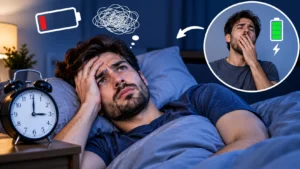

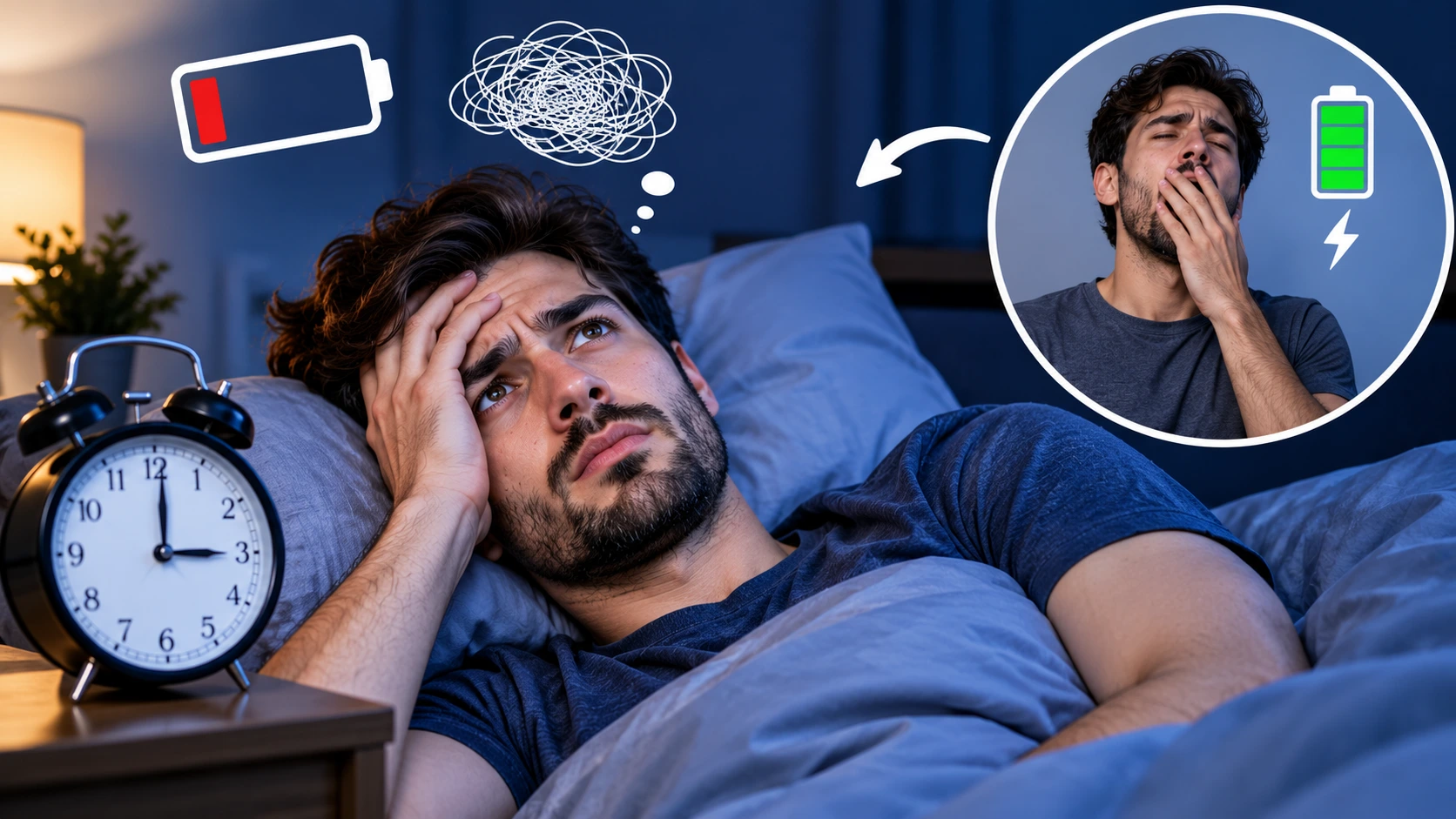
You’ve had a long day. You’re genuinely worn out — the kind of tired that makes your eyes burn. You get into bed, pull the blankets up, and then absolutely nothing happens. Your brain turns on. Your thoughts start running. You lie there staring at the ceiling wondering why your body won’t do the one thing it clearly needs to do.
If this sounds familiar, you’re not alone — and there’s nothing wrong with your discipline or your willpower. The reason you’re tired but can’t fall asleep usually has nothing to do with effort. It has to do with what’s happening in your nervous system.
Here’s what’s actually going on.
Your Brain and Body Can Be Exhausted at the Same Time
This is the part most people don’t realise. Physical tiredness and sleep readiness are not the same thing. You can be completely depleted physically and still have a nervous system that’s running too hot to let you drop off.
Sleep requires your brain to downshift — heart rate slows, body temperature drops slightly, and brain activity transitions into the slower wave patterns that lead into sleep. When you’re under stress, overwhelmed, or anxious, your body is in a mild state of physiological activation. Cortisol and adrenaline are still circulating. Your system is primed to respond to a threat that hasn’t gone away just because you’ve got into bed.
That’s the core of what’s happening when you’re exhausted but can’t sleep at night. Your body is tired. Your nervous system hasn’t had the signal that it’s safe to let go.
The Most Common Causes of Trouble Falling Asleep
Causes of trouble falling asleep vary from person to person, but a handful of things account for the majority of cases.
Anxiety is the most common one. Even low-grade, background anxiety — the kind you might not even label as anxiety during the day — tends to surface at night when distractions disappear. The mental noise you’ve been keeping at bay with activity and screens becomes impossible to ignore the moment your head hits the pillow. Anxiety and difficulty sleeping are closely linked, and treating one almost always improves the other. If anxiety is running underneath your sleep problems, it’s worth addressing directly — the anxiety treatment options at Psychiatry Relief cover this in more detail.
Racing thoughts at night are often anxiety in disguise — your mind cycling through tomorrow’s to-do list, conversations you replayed, decisions you haven’t made yet, or fears you couldn’t quite articulate during the day. This racing mind before bed is one of the most common presentations of sleep onset insomnia, and it’s not a character flaw. It’s a nervous system that hasn’t been given a proper off-ramp.
Overstimulation before bed is a bigger factor than most people give it credit for. Screens, news, high-stakes conversations, stressful email threads — all of these keep the brain in an activated state. The transition from screen to sleep is too abrupt for most people’s nervous systems to manage smoothly.
Irregular sleep schedules confuse your circadian rhythm — your body’s internal clock. If you go to bed at 10pm some nights and 1am on others, your body doesn’t know when it’s supposed to wind down, so it doesn’t do it reliably.
Caffeine timing is something a lot of people underestimate. Caffeine has a half-life of around five to six hours, which means a 4pm coffee still has a significant amount of stimulant in your system at 10pm.
Underlying mental health conditions including depression, PTSD, ADHD, and anxiety disorders frequently cause or worsen difficulty falling asleep. If sleep problems are persistent, talking to a clinician rather than just adjusting habits is often the more efficient path. The services at Psychiatry Relief cover psychiatric evaluation and treatment for all of these.
Why Am I So Tired But Can’t Sleep? The Role of Cortisol
Why am I so tired but can’t sleep is a question that often points to chronic stress more than anything else.
When you’re under sustained stress — work pressure, relationship strain, financial worry, or just the accumulated weight of a demanding life — your body produces elevated cortisol over time. Cortisol is meant to be highest in the morning to help you wake up and lowest in the evening to allow sleep. Chronic stress disrupts this pattern, keeping cortisol elevated at night when it should be dropping.
The result is nighttime anxiety and stress that shows up as hyperarousal — lying awake, feeling wired even though you’re exhausted, being unable to quiet your thoughts. Your body is running an emergency programme that wasn’t designed for modern stressors. It doesn’t distinguish between a genuine physical threat and a looming work deadline. It responds the same way to both.
This is also why sleep onset insomnia — the specific difficulty of falling asleep, as opposed to staying asleep — tends to be closely linked to anxiety and stress rather than purely physical causes. The body will eventually sleep from sheer necessity, but the brain keeps fighting it.
How to Fall Asleep When Exhausted: What Actually Helps
How to fall asleep when exhausted when your mind won’t cooperate comes down to giving your nervous system an actual off-ramp, not just lying in the dark hoping for the best.
A wind-down window matters more than most people think. Forty-five minutes to an hour of genuinely low-stimulation activity before bed — not scrolling, not watching something intense, not answering messages — gives your nervous system time to transition. Reading, light stretching, a warm shower or bath (which paradoxically helps by lowering core body temperature afterwards), or simply sitting quietly all count.
Relaxation techniques for better sleep that have solid evidence behind them include:
- Progressive muscle relaxation — systematically tensing and releasing muscle groups from feet to head, which interrupts the physical tension loop that stress creates
- Diaphragmatic breathing — slow, deliberate breathing that activates the parasympathetic nervous system (the rest-and-digest mode that counteracts the fight-or-flight state keeping you awake)
- Cognitive shuffling — a technique where you deliberately generate random, unconnected mental images, which mimics the hypnagogic thought pattern that naturally precedes sleep and helps interrupt racing thoughts at night
Sleep hygiene tips are genuinely useful when applied consistently: a fixed wake time (more impactful than a fixed bedtime), a cool and dark room, no caffeine after 2pm, keeping the bed associated only with sleep rather than screens or work. These aren’t magic — but they give your circadian rhythm the environmental cues it needs to function properly.
Writing things down before bed helps more than most people expect. If your racing mind before bed is driven by unfinished mental loops — things you need to remember, decisions you haven’t resolved — a brief brain dump into a notebook gives your mind permission to let go of them until morning. You don’t need to solve anything. Just write it down.
When Sleep Problems Need Professional Support
There’s a point where adjusting habits isn’t enough — and it’s worth knowing when that point is.
If you’ve had difficulty falling asleep consistently for more than a few weeks, if it’s affecting your functioning during the day, if nighttime anxiety and stress feels overwhelming rather than manageable, or if you suspect an underlying condition like depression, ADHD, or an anxiety disorder is driving the sleep disruption — those are the situations where speaking with a clinician makes sense.
Sleep hygiene tips and relaxation techniques for better sleep are real tools, but they address the surface layer. If anxiety, depression, or another condition is the root cause, treating that directly typically resolves the sleep problems alongside it rather than working around them indefinitely.
Cognitive Behavioural Therapy for Insomnia (CBT-I) is the gold-standard psychological treatment for chronic sleep onset insomnia and has stronger long-term outcomes than sleep medication for most people. Medication can play a role in certain cases — but it’s most effective as part of a broader treatment plan rather than a standalone fix. The clinicians at Psychiatry Relief work with patients on exactly this kind of integrated approach.
According to the Sleep Foundation, sleep onset insomnia affects a significant portion of adults, and anxiety and difficulty sleeping are among the most commonly co-occurring conditions — meaning treating the anxiety is often the most direct route to better sleep.
Ready to Sleep Better? Talk to Someone Who Can Actually Help.
If lying awake exhausted has become your normal, it doesn’t have to stay that way. Psychiatry Relief offers compassionate, evidence-based care for anxiety, depression, insomnia, and the conditions that drive them — in-person in Houston, TX and via telehealth.
Book an Appointment at Psychiatry Relief →
Or contact us with any questions before booking. Every mind matters.
Frequently Asked Questions
Why can’t I fall asleep even when I’m exhausted?
Physical exhaustion and sleep readiness are separate. When your nervous system is in an activated state — from stress, anxiety and difficulty sleeping, or high cortisol levels — it resists the downshift sleep requires. Being tired but can’t fall asleep is usually a nervous system issue, not a willpower one.
What causes the feeling of being exhausted but unable to sleep?
The most common causes include anxiety and difficulty sleeping, racing thoughts at night, irregular sleep schedules, overstimulation before bed, caffeine timing, and underlying conditions like depression or ADHD. Nighttime anxiety and stress is the most frequent driver of sleep onset insomnia in adults.
Does anxiety cause difficulty falling asleep?
Yes — it’s one of the most direct links in sleep medicine. Anxiety and difficulty sleeping tend to reinforce each other: anxiety makes it harder to fall asleep, and sleep deprivation increases anxiety the following day. Addressing the anxiety directly, rather than just adjusting sleep habits, often resolves both issues. Psychiatry Relief offers anxiety treatment for exactly this.
What are the best relaxation techniques for better sleep?
Relaxation techniques for better sleep with solid evidence include diaphragmatic breathing, progressive muscle relaxation, and cognitive shuffling. A consistent wind-down routine — 45 minutes of low-stimulation activity before bed — also gives the nervous system time to transition out of its activated daytime state.
What sleep hygiene tips actually make a difference?
The most impactful sleep hygiene tips are: a fixed wake time (even on weekends), no caffeine after 2pm, keeping screens out of the wind-down window, a cool and dark room, and keeping the bed associated only with sleep. A brain dump notebook before bed helps if racing mind before bed is a persistent problem.
When should I see a professional about difficulty falling asleep?
If difficulty falling asleep has persisted for more than a few weeks, is affecting daytime functioning, or feels connected to anxiety, depression, or another underlying condition — speaking with a clinician is the right move. Book an appointment at Psychiatry Relief for a full evaluation and a treatment plan built around your specific situation.